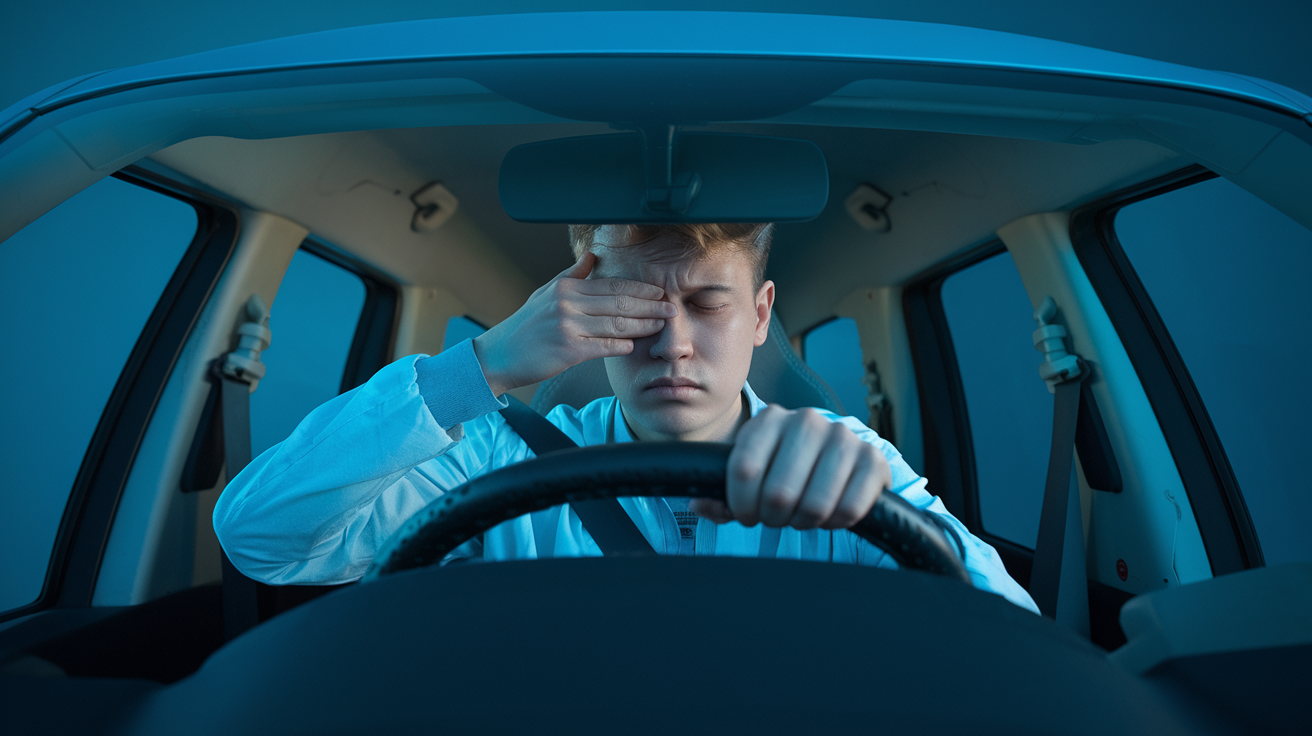

Sleep apnea almost killed my neighbor. He's fine now, but that's not really the point — the point is he drove 45 minutes each way to work for about 6 years while stopping breathing 47 times an hour at night. Six years. And he felt tired, sure, but he felt like anyone feels tired. Didn't know there was a clinical reason. His wife kept jabbing him in the side when the snoring got bad, neither of them thought it was dangerous, just annoying. Then he rear-ended someone on Route 9 in Framingham on a Tuesday morning. Nobody hurt. But he told me later he genuinely didn't see it happen — he was there, and then the airbag was in his face and there was the smell of burned rubber. He doesn't remember closing his eyes. He never does, he said. That's the whole thing right there.
I keep thinking about how long that gap actually was. The time between "driving normally" and "airbag deployed" — what was happening inside his skull during that stretch? The neuroscience has a name for it: microsleep. Not feeling tired. Not drifting. Brain activity going essentially flat while you appear to be awake, sometimes with your eyes open. It's been documented on EEG in lab settings. Subjects don't report experiencing it. They just have lost time they can't account for. At highway speed, that lost time is measured in football fields.
My neighbor's apnea was moderate-severe — AHI of 47 in his sleep study. That's 47 breathing interruptions per hour. Every night. For years. Each interruption kicks the brain out of deep sleep just enough to restart breathing, not enough to wake you up consciously, never enough to let you cycle through proper restorative sleep. Your body runs a deficit. The deficit compounds. And then you get in a car.
The crash data on this is not ambiguous. People with untreated obstructive sleep apnea have roughly 2.5 times the crash risk of normal sleepers. Some studies put it higher — a 2015 meta-analysis in Sleep Medicine Reviews found ranges from 1.2x to nearly 5x across different study methodologies. The consistent message across two decades of research: this is a real, dose-dependent effect. Worse apnea, worse outcomes.
What Makes This Different From Just Being Tired
Regular tiredness you can feel. You know when you stayed up too late. You know when the baby woke you up three times. You have an accurate internal sense of how sleep-deprived you are, and that sense usually makes you more cautious.
Chronic sleep fragmentation from apnea does something different — it recalibrates your baseline. You stop knowing what rested feels like because you haven't been rested in years. Your subjective sense of alertness decouples from your actual performance. David Dinges at Penn has studied this specifically: people under chronic partial sleep restriction consistently underestimate their level of impairment compared to what objective performance tests show. You feel okay. The tests say otherwise. This mismatch is the dangerous part.
And what gets hammered hardest is the prefrontal cortex — the exact cognitive equipment driving requires. Sustained attention, anticipatory reasoning, fast situational assessment, decision-making under uncertainty. All of it degrades with sleep loss faster than simpler cognitive tasks. Your reaction time slows to blood-alcohol-comparable levels without any of the subjective intoxication signals that would make you reconsider getting in the car.
So you just... drive. Because you feel like you usually feel. Which is impaired, but you don't know it.
Microsleep Is the Mechanism
I want to be specific about what microsleep actually is because I think people hear "nodding off" and imagine something gentler than the reality.

Visual overview: Key facts about sleep apnea and driving safety risks
Microsleep is a documented neurological event. On EEG, you see brain activity drop to near-sleep patterns for a brief period — could be half a second, could be 30 seconds — in a person who looks awake. Eyes might be open. The person won't report it as sleep. Usually has no memory of it. The brain just... briefly checked out.
Five seconds at 70 mph is 513 feet. That's the distance traveled while your brain is briefly offline and your hands are loosely on the steering wheel. That's not a metaphor. That's math about physics.
For someone carrying the kind of sleep debt that comes with untreated apnea — especially higher AHI numbers — microsleep frequency increases. The brain is running a recovery deficit and it will find ways to collect. It doesn't care that you're on I-95. It will do what it does.
The warning signs people describe: not being able to account for the last couple miles, drifting and being woken by a rumble strip, head dropping. Late warning signals. If they're happening, the correct move is immediate: pull off somewhere safe, now, not at the next convenient exit.
Legal Exposure (The Part Doctors Don't Usually Mention)
There's a legal dimension to diagnosed, untreated sleep apnea that doesn't come up enough in clinical conversations. New Jersey passed Maggie's Law back in 2003 — explicitly making knowingly drowsy driving (after 24+ sleepless hours) a criminal offense, named after Maggie McDonnell who was killed by such a driver. A handful of states have followed. The general trend is toward drowsy driving being treated with greater legal gravity.
The civil piece matters more for most apnea patients though. If you have a documented diagnosis — meaning it's in your medical records — and documented treatment recommendations, and you're subsequently in an accident, that documentation is discoverable in litigation. Personal injury attorneys request medical records. The gap between "diagnosis received" and "accident occurred" tells a story in court about whether you knew about a condition that impairs driving and chose not to address it.
Pre-diagnosis: plausible deniability. Post-diagnosis: not really. This is what getting diagnosed actually changes about your legal situation, and it's worth knowing.
Commercial Drivers
The FMCSA has been tightening screening protocols over the past decade. DOT physicals now actively screen for sleep apnea risk — BMI over 35, neck circumference above 17 inches in men, hypertension, reported sleepiness during the day. Flagged drivers can be required to complete a sleep study before their certificate is renewed. Diagnosed drivers must be treatment-compliant. Non-compliance risks the certificate, and without the certificate there's no CDL.
I've heard the "if I get tested I'll lose my job" argument a lot. It gets the causality backwards. The actual career-ender is a serious at-fault accident. The evaluation-and-treatment path is what makes the career survivable long-term.
Treatment: The Good News
Longitudinal studies tracking CPAP-compliant patients show crash rates normalizing toward baseline over time. The impairment from apnea is reversible because it's a downstream effect of disrupted sleep, not permanent neurological damage. Fix the sleep, restore the driving performance.
CPAP works when people use it. Real-world compliance is the problem — around 50% consistent use in the research literature, which means roughly half of prescribed patients aren't effectively treating their apnea. For those people, surgical options are worth actual serious consideration rather than just living with the problem.
UPPP — uvulopalatopharyngoplasty — has been done for decades and removes obstructive soft tissue from the back of the throat. Good track record for appropriate anatomies. Maxillomandibular advancement physically repositions the jaw to open the airway permanently; success rates are high for well-selected moderate-to-severe cases. Septoplasty addresses nasal obstruction specifically — often a contributing factor — and can improve CPAP tolerability even for people who don't need surgery for the apnea itself.
Inspire
Worth understanding Inspire hypoglossal nerve stimulation: implanted device (generator near collarbone, breathing sensor near the ribcage, stimulation lead near the nerve controlling tongue position) that fires at the right moment in your breathing cycle to prevent airway obstruction. No mask. No hose. Remote to turn on before sleeping. Covered now by most major insurers for patients who qualify anatomically and meet severity criteria. Multicenter clinical trials showed significant AHI reduction; patient-reported outcomes are substantially better than prior CPAP attempts for this population.
What Helps in the Meantime
Between evaluation and effective treatment, some practical risk reduction:
Timing matters. The post-lunch dip (roughly 2–4 PM) and the overnight low (midnight to 6 AM) are peak microsleep windows physiologically. Long solo drives in those windows carry more risk. Morning is generally safer.
A 20-minute nap genuinely outperforms caffeine. Not because caffeine doesn't help at all — it delays the next alertness crash by blocking adenosine — but because it doesn't address the underlying deficit. Actual sleep, even brief sleep, allows some recovery. Rest area, seat back, phone timer set, 20 minutes. This works and is underused.
Having someone in the car is a safety system. They observe things about your state that you can't observe from inside your own head. Use this option when it's available.
The Conversation About Someone Else
A lot of people end up here not for themselves but because they're worried about someone they love. A parent who falls asleep watching TV every single time they sit still for more than 10 minutes and still drives 40 minutes to church every Sunday. A spouse who described "almost drifting" on the highway two weeks ago in a tone that was way too casual about something that should have been alarming.
The conversation that works: specific observations, stated plainly, from visible and genuine worry. Not diagnosis, not conclusions, not a plan for what they need to do. "What you mentioned about almost drifting last month on 95 — I keep thinking about it. It scared me." Then stop talking.
What they say next will tell you what the real resistance is. Almost always it comes back to independence — loss of independence, change of identity, fear that admitting something is wrong means losing something they're not ready to lose. The honest reframe: treating apnea is what preserves independent driving. The path that ends driving is the accident, or the failed DOT physical, or the family intervention after a second close call. Treatment is what makes driving sustainable.
How to Actually Get Started
Sleep study. That's where everything begins. In-lab polysomnography gives the most complete picture (AHI, oxygen saturation, sleep stages, arousal index, respiratory effort) and is the gold standard. Home sleep tests are faster, more accessible, covered by most insurance, and adequate for most diagnostic purposes though they systematically undercount events slightly. Primary care can order either. Sleep medicine clinics usually schedule within a few weeks.
The specialist you see for treatment matters. There's a real difference between a provider who will prescribe CPAP and send you to a DME supplier versus one who will assess your anatomy, discuss surgical options, and follow you through the process. The provider directory here covers sleep apnea specialists by location and procedure focus — useful for finding someone whose practice actually matches your situation.
The patient journey section walks through what the process looks like from initial evaluation through treatment — which most people find considerably more manageable than they expected once they started.
My neighbor, by the way — the one who rear-ended someone in Framingham — he's on CPAP now. Goes to sleep with it on every night. His wife stopped jabbing him in the side. He told me last fall that he'd forgotten what it felt like to wake up actually rested, and the first morning after a good CPAP night he just sat on the edge of the bed for a while trying to figure out what felt different. That's what this is about. Not just the driving. But the driving too.