Dave is 53. Accountant. Coaches Little League on weekends in Mesa, Arizona. Had a stroke in April 2025.
"Out of nowhere," his wife Rachel told me. And I get why she said that — there was no warning that looked like a warning. No chest pain clutching event, no dramatic collapse. He woke up April 11th unable to find words for things. Cup. Door. Rachel's name. Called 911 himself because he still had his phone and knew something was wrong. That part still gets me.
But it wasn't out of nowhere. Rachel had been sleeping in the guest room since late 2019 because of the snoring. His GP had flagged sleep apnea twice. Dave had a sleep study referral in his kitchen junk drawer for eight months — still in the envelope, never opened. He kept meaning to deal with it.
I think about this a lot because I've gone deep into the research on sleep apnea and heart disease, and the connection is not subtle or theoretical. It's mechanistic and specific and documented. Here's the version I wish Dave's doctor had told him in 2021.
Every apnea event — every time breathing stops — oxygen in the blood drops. Fast, sometimes dramatically. The brain detects danger and hits the sympathetic nervous system like a fire alarm. Blood pressure jumps 25, 30 points. Heart rate jolts. Cortisol and adrenaline flood the body. Then breathing resumes, pressure comes down, and maybe 8 or 10 minutes later it happens again. People with severe apnea do this 80, 100 times an hour. Dave's AHI — his apnea-hypopnea index, the events-per-hour count — was 74 when they finally tested him in May. After the stroke.
74 events an hour. 8 hours of sleep. That's nearly 600 times in a single night his cardiovascular system ran what it treats as an emergency response. Not occasionally. Every night for years. The heart keeps score.
The blood pressure story is the one that makes cardiologists most frustrated when they finally understand it. There's a documented phenomenon called non-dipping hypertension — normally blood pressure falls 10-20% during sleep, which is part of how the body repairs itself. Apnea patients often show the reverse. Pressure stays elevated or actually climbs while they sleep. Years of this resets the body's baseline upward. A 2000 study in the New England Journal of Medicine — one of the landmark ones — confirmed that even mild sleep apnea significantly raises hypertension risk. The part nobody explains clearly enough: if you're already taking antihypertensives and you've got untreated sleep apnea underneath it, the medications often underperform. Cardiologist adds a second drug, adjusts doses. Numbers don't cooperate. Nobody asked about the snoring.
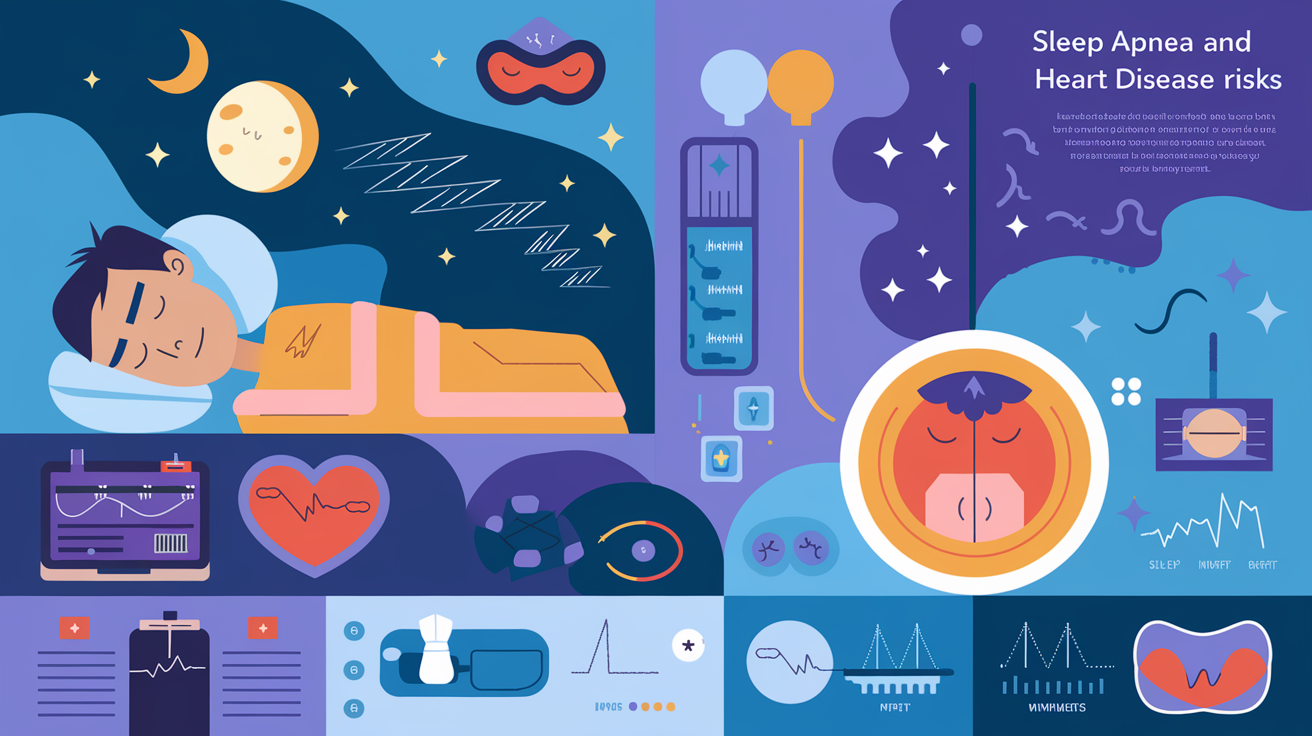
Visual overview: Key facts about sleep apnea and heart disease risks explained
Then there's the AFib connection, which — honestly — I didn't fully understand until I went looking. Atrial fibrillation shows up in 30 to 50 percent of sleep apnea patients depending on the study. Electrophysiologists at major cardiac centers now screen essentially every AFib patient for sleep apnea. Some won't do ablation procedures until it's addressed, because recurrence rates are higher when untreated apnea is running in the background. The mechanism: all that nightly pressure variation and oxygen cycling physically stretches the atrial walls. Repeated, accumulated stretching creates the substrate for chaotic electrical signals. AFib. And once AFib starts, stroke risk is five times higher. Dave was in that chain. His AHI of 74, years of it, and then AFib nobody knew about, and then April 11th.
None of this announces itself. That's the thing. Blood pressure creeps. Maybe some palpitations that feel like anxiety. Maybe some fatigue that gets attributed to stress or age. The actual cardiac event arrives years after the damage started. By the time something happens, you've been in that trajectory a long time.
So — practical things. Blood pressure that doesn't respond the way it should to medication. Waking at 3am with your heart pounding. Morning headaches that lift by midday. A partner telling you that between snores you go still and silent and then gasp awake. Exhaustion out of proportion to sleep hours. Any of these is worth raising directly with whoever is managing your cardiovascular care — not as an aside, but as a primary question. And if you're a woman and none of the classic sleep apnea picture feels like you — the loud overweight snoring man — know that sleep apnea in women often looks more like insomnia and fatigue and depression. The screening criteria historically were built around men. You may need to push.
CPAP works when people actually use it. The cardiovascular benefits are documented — blood pressure improvement, AFib recurrence reduction, better cardiac outcomes. Problem is real-world compliance. A lot of people technically have a CPAP that gets four hours a night on good days, and that's not the same as treatment. For people who genuinely can't tolerate it, Inspire therapy — an implantable nerve stimulator — has been a real option. Structural fixes like septoplasty can address nasal obstruction at the source. Palate surgery or jaw advancement can open the airway permanently for the right anatomy. Our procedure guides go into real costs and what to expect if you want to get specific.
The piece that almost never happens but should: your sleep doctor and your cardiologist talking to each other. Most people see them separately. You have to be the one who carries information between them — sleep study results to the cardiologist, cardiac history to the sleep specialist. If surgery is on the table and there's any cardiac complication in your history, the surgical team needs the full picture. Surgeons experienced with medically complex patients exist and they matter.
Dave is on CPAP now. Since June. Blood pressure finally where it should be. Rachel is back in the main bedroom. He finds the mask claustrophobic, hates it honestly, probably should look into surgical options at this point given how much he resists it. But he's using it. He's treating it.
Just took a stroke to get there. Please don't wait for that.